
Subsidized Rehearsal
For most of modern computing, the asymmetry pointed in one direction. Corporations could afford the expensive productive resources: skilled labor, infrastructure, compute, distribution, and the organizational machinery needed to turn ideas into reality. Individuals could have ideas, but execution was costly enough that most ideas had almost no economic value on their own.
The current AI market has temporarily reversed one narrow part of that relationship.
Frontier labs sell individuals flat-rate access to models while companies increasingly buy the same underlying capacity by the token. My estimate suggests I get 20 to 40 times the usage value of my subscription compared to buying the same volume through metered APIs. A $200 monthly plan can conceal an inferred expense that, when a company buys it, begins to look similar to the monthly salary of a senior knowledge worker.
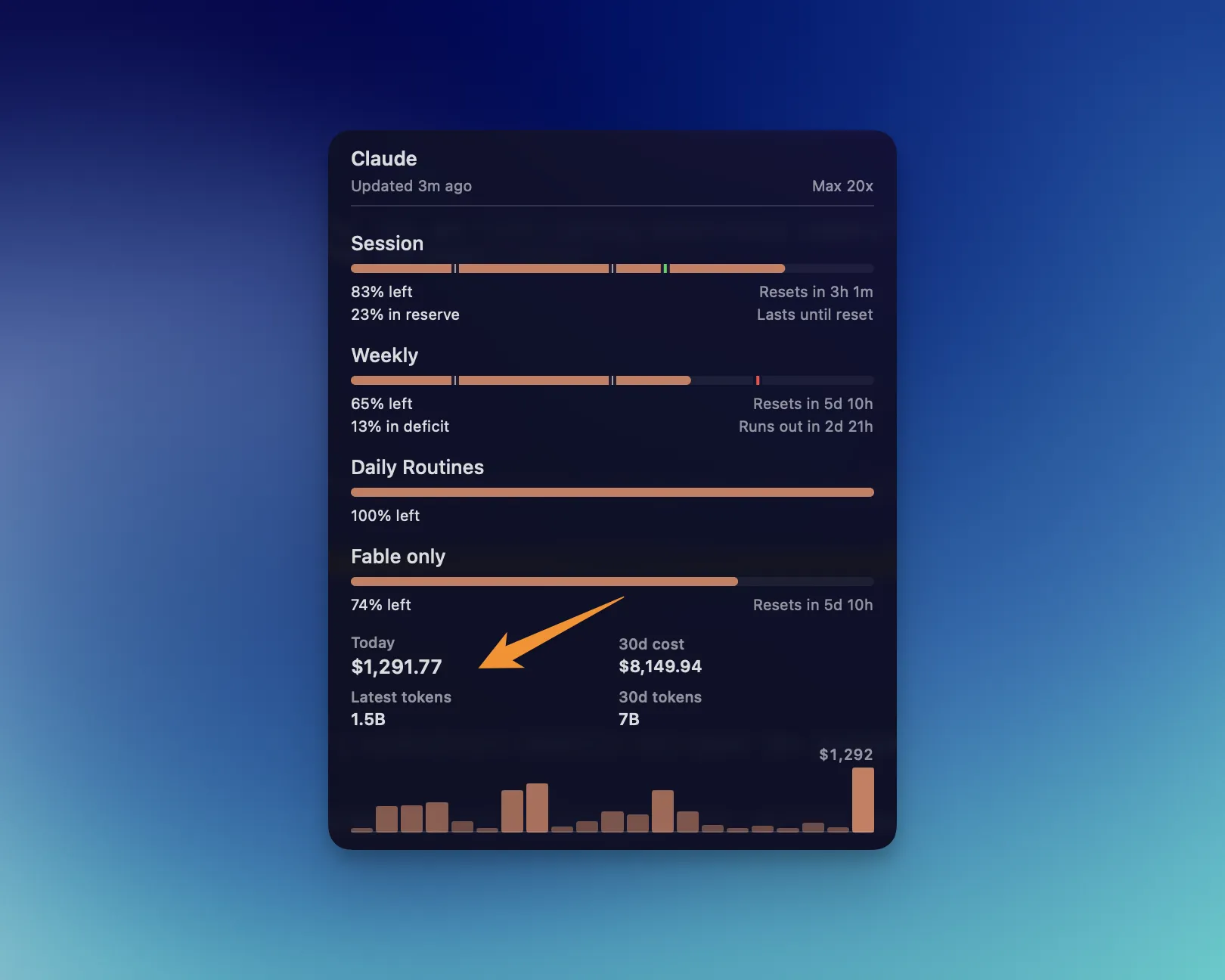
The comparison is imperfect. Enterprise buyers also pay for privacy, procurement, service guarantees, predictable access, and auditability — and I'm not claiming individuals now out-resource corporations. But remove those concerns and the price difference remains absurd: one person can access frontier-model capacity at a far lower marginal cost than the companies around them, and experiment with it far more freely.
Consumer subsidies have a long history. For example, MoviePass offered tickets below cost, Uber invested heavily to keep ride prices low, and streaming services provide access to extensive music and TV content that individuals couldn't afford on their own. These services effectively subsidized consumption[1].
AI subscriptions subsidize production
Research, code, design, analysis, iteration, and marketing[2] are being bundled into a consumer plan. AWS never gave individuals nearly unlimited compute while charging companies the nominal rate. The unusual part of the current AI market is what's being discounted: general-purpose, skilled execution.
The pricing model changes who can afford uncertainty.
A company on metered billing sees the underlying economics almost immediately. It can spend months acting as if inference were abundant, only to discover how expensive its actual usage is when every token appears on a bill. It sees a cost attached to every experiment, background process, abandoned direction, or tool call. It has to decide which ideas deserve resources before it can know whether they work.
The individual experiences the opposite incentive. Once the subscription is paid, the next attempt feels free. That changes who can afford uncertainty. A company usually has to justify resources before executing an uncertain idea. An individual can execute first, inspect the result, and decide afterward whether the idea deserves further investment. The idea becomes a cheap option: the downside is capped by the subscription and personal time, while the upside can be much larger.
The corporation has to invest before it can get evidence.
That difference changes an idea's value. An untested idea is still worth very little. What changes is the cost of turning it into something you can inspect and use: a prototype, a workflow, an analysis, a piece of software. The subscription gives one person a fixed-price option on a large number of attempts. Most will go nowhere. One may repay the rest.
I realized the true extent of that option only after months of living on both sides of it. The company I work for recently switched to metered enterprise billing; my personal subscriptions stayed flat. At work, every experiment now has a visible price. At home, the next attempt still feels free.
During that time, I built a ridiculous number of things I had always wanted to build. Most were not startup ideas. I did not expect them to make money, attract users, or grow into anything larger. Some were for me, some for my family or friends, and some for a handful of people with the same oddly specific problem. I wanted to see them exist. I wanted the pleasure, experience, and frequent frustration of turning an idea into reality. Many of my friends have been doing the same[3].
Until recently, most of those ideas would have stayed on a list. Even a small digital project demanded enough engineering[4], research, and stubborn debugging to justify it. Under a flat AI subscription, curiosity was enough.
The hobby phase
The lack of pressure to deliver made the experimentation useful. I could choose the wrong architecture, ask for an unnecessary feature, rebuild something twice/thrice, follow a strange tangent, and abandon the whole project without needing to explain the expense. Some experiments became useful tools. Others were simply enjoyable. Almost all of them taught me something about how to work with these systems.
I think of it as subsidized rehearsal.
At enterprise rates, an abandoned attempt appears as waste. Under a flat subscription, the same attempt can be tuition. I mostly learned to coordinate and work with these systems to the point that I consistently achieved good results and could move up the ladder in project complexity. The models handled all of the execution; I built the judgment and the surrounding machinery.
Those skills travel. At work, I can now look unusually efficient with AI, or simply like someone who gets good results from it. The visible performance rests on a large body of private experimentation that would have been difficult to justify on a corporate bill. The individual and the model lab financed the apprenticeship; the employer may later benefit from the capability.[5]
The obvious objection is that none of this has made money. But captured value and monetized value are not the same thing. The value is already there in the joy of making things, in the small tools that solve real problems for a few people, and in the ability to turn vague ideas into working systems. I'm scratching the itch. It is also there in the accumulated skill, judgment, and confidence that now travel into every new project.
What I ask myself now is whether that capability can become durable economic value: a product, an asset, a small institution, or a new way of working. Something that survives the repricing — because the repricing is coming, for companies first and eventually for the rest of us. There is no such thing as a free lunch.
OpenClaw is the absurd, cautionary example of how far this can go.
Peter Steinberger describes building it alone, with several Codex sessions running in parallel and agentic engineering writing nearly all the code. He also described spending about $1,000[6] a month across consumer subscriptions for usage he estimated would cost five to ten times more through APIs. Consumer-priced inference helped one person build a production system that itself coordinates agents. (The later stories about a hundred concurrent agents and enormous API-equivalent bills came after OpenAI started covering his costs; the earlier, consumer-priced build is the fair benchmark.)
The subsidy became code, workflows, infrastructure, and an ecosystem that could command even more artificial labor[7]. It shows that subsidized execution can carry an individual well beyond validation and into maintained infrastructure. It also shows where the story tends to end, and this is the cautionary part: the subsidy's most successful individual output was absorbed by a lab, along with its author. The value was real, and the ecosystem captured it.
OpenClaw is notable for its scale, yet a simple search reveals many similar cases[8]: unusual individuals taking on extraordinary workloads, effectively forming small engineering and product teams through consumer subscriptions.
And also destroyed a lot of things in the process, but that is a different blog post. ↩︎
A very simplified and non-exhaustive list of tasks. ↩︎
It's incredible to see things shared and produced live. I have a Telegram group with 6-7 friends, also heavy users, sharing experiments and learnings. Many moments of "wow, I couldn't imagine we could build that." ↩︎
I'm fairly technical; I can understand software architecture very well, and I've been building software for over 20 years now, but I don't have the domain over programming languages, so that itself would be a non-starter for any of those ideas. ↩︎
As I write this, I recall how my friends and I learned to use Photoshop, Lightroom, and InDesign by using pirated copies and experimenting in our free time. Eventually, that knowledge helped us build careers in that field. So, some of that "subsidy" (piracy, in that case) analogy paid off back then. ↩︎
Too early to cite Universal Paperclips? ↩︎
Kieran Klaassen writes that Claude Code opened all of his pull requests for Cora and let him work with four agents in parallel. Ravi, writing as rikuq, reports building three live SaaS products with a $200 Claude Max subscription. Kieran's account / Ravi's account ↩︎
The taxi meter is coming for us all
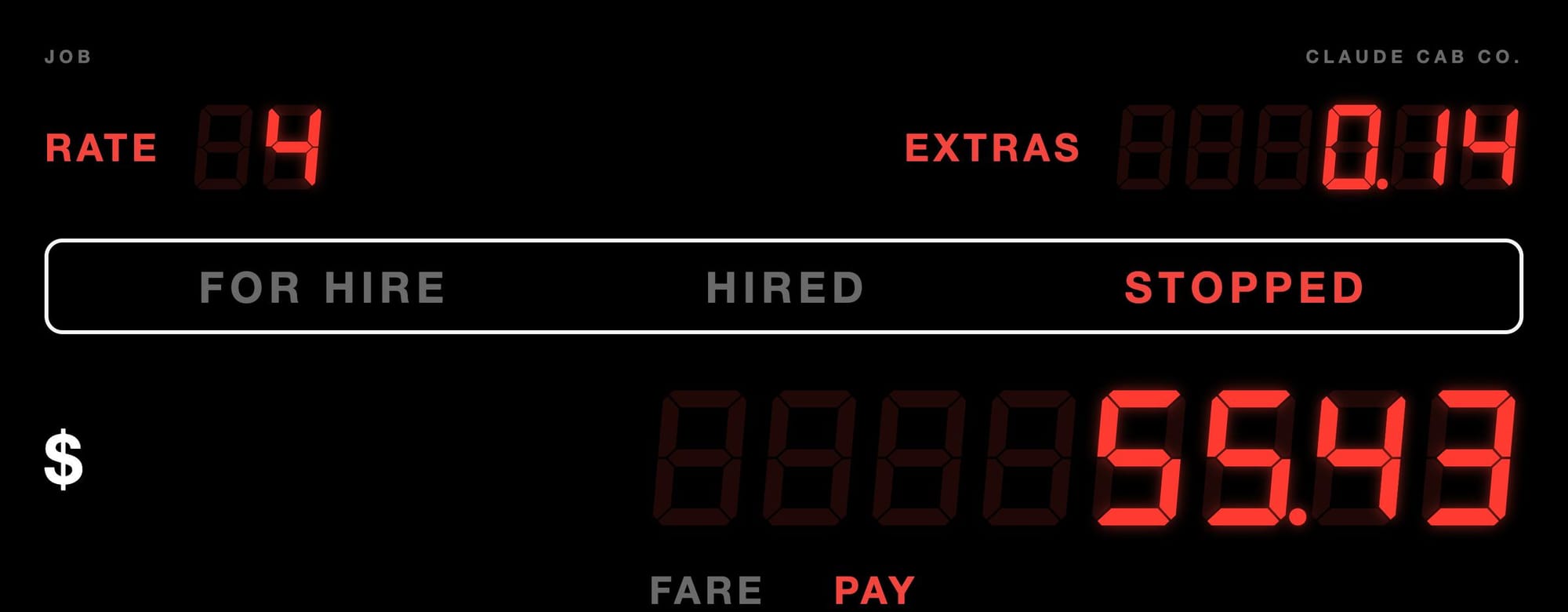
This inversion is temporary. At some point the 20–40x subsidy will stop. But what's created inside it doesn't have to end with it: software, workflows, knowledge, an audience, a way of operating — all of that survives the repricing.
That is the difference from the older consumer subsidies. When MoviePass and Uber stopped burning money, what remained on the consumer side was mostly habits and a few dead apps. Subsidized consumption, once the discount ends, leaves little behind. Subsidized production leaves artifacts.
I cannot yet say that I have turned the mismatch into a business or captured its full economic upside. Mostly, I used it to play, learn and make things for people I care about. That already feels like a good return.
Watching the meter reappear makes the remaining question harder to ignore: now that I can see this subsidy for what it is, and can see the economics beginning to close, what should I use it to build while it still exists?
The question isn't only mine.
No spam, no sharing to third party. Only you and me.
Member discussion